Money, and How to Decide
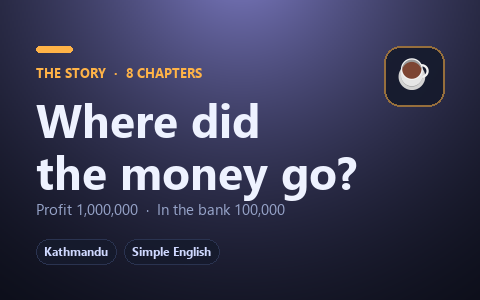
You do not need to know anything about finance to follow today. We start with one small coffee company in Kathmandu. It made a profit of 1 million rupees last year, and it has 100,000 rupees in the bank. That does not seem possible, and finding out why is how the whole course begins.
Every idea in this subject appears in that one story: how to read a company's numbers, how to compare two companies, why money today is worth more than money later, how to price a promise, how to decide about a big purchase, why risk changes the answer, and who the money finally belongs to. Nothing is explained with a formula before it is explained with the story.
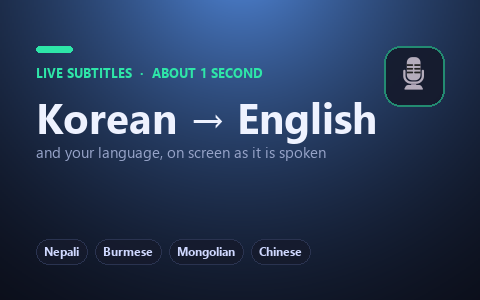
The class is taught in English. Some parts are said in Korean, and for those moments the Live Subtitles page on your phone shows every sentence in English and in Nepali, usually within about a second. If anything is still unclear afterwards, the Ask the Course page will answer questions about this class at any hour.

⏱ Today, in 30 minutes
| 0–3 | Remembering those lost in the floods | Memorial |
| 3–6 | A company made money. The money is missing. | Ch. 1 |
| 6–13 | Two simple pages, and numbers that talk back | Ch. 2–3 |
| 13–20 | Money today is not money later · what a promise is worth | Ch. 4–5 |
| 20–26 | Should we buy the machine? · why the rate changes everything | Ch. 6–7 |
| 26–30 | Borrow or use our own? · what the semester looks like | Ch. 8 |