Hierarchical Binary Classification with LightGBM
This study developed a protein function prediction pipeline for the CAFA6 (Critical Assessment of Functional Annotation) challenge. We employ a Hierarchical Binary Classification approach utilizing the Gene Ontology (GO) hierarchy structure, with LightGBM models and GPU acceleration for efficient training.
Per-GO-term dataset construction with 6:2:2 train/valid/test split within each term.
Models trained for all GO terms with ≥50 positive samples, from leaf nodes to root.
Gradient boosting models with GPU acceleration for fast training on large-scale data.
Joblib-based parallel model training to maximize computational efficiency.
Information Accretion (IA) weights re-normalized for each subset with dual F-max evaluation.
Ancestor propagation ensures GO hierarchy consistency in final predictions.
Load GO ontology, training sequences, and annotations
Extract amino acid composition, physicochemical properties, and ESM-2 embeddings
Compute Information Accretion weights for each GO term
Train LightGBM binary classifiers for each eligible GO term
Generate predictions with True Path Rule propagation
Calculate IA-weighted and unweighted F-max scores
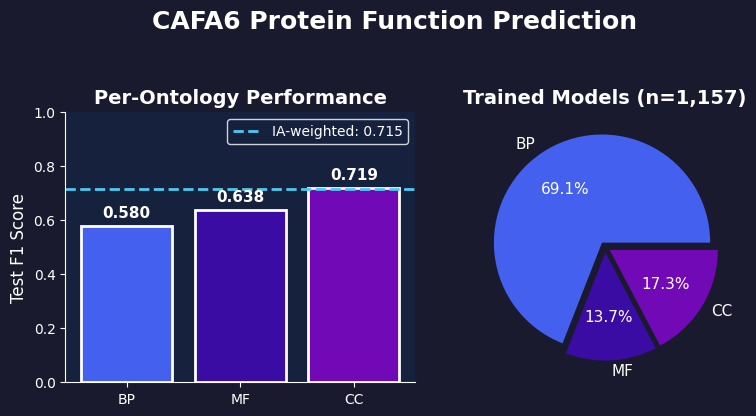
The pipeline successfully trained 1,157 hierarchical binary classification models for protein function prediction across three GO ontologies: Biological Process (BP), Molecular Function (MF), and Cellular Component (CC). The model achieved an IA-weighted test F-max of 0.7147 and AUC of 0.6996.
| Ontology | Models | Valid F1 | Test F1 | Valid AUC |
|---|---|---|---|---|
| BP | 799 | 0.5928 | 0.5796 | 0.6745 |
| MF | 158 | 0.6611 | 0.6385 | 0.7168 |
| CC | 200 | 0.7323 | 0.7189 | 0.7478 |